
Have a Good Forever
Stephen Mooney
Never again will you be able to justify a self-indulgent act by stating that you only live once. Infinite existence is a given fact of the nature of the Universe.
I'm not talking about reincarnation, where you come back as a cat or some other biological species. And I'm most certainly not talking about religion in any shape or form. I'm talking about a fundamental aspect of how the Universe works. I'm also talking about how physics, for all its success in the area of technology, went off the rails early last century.
It was around 1923 that the American astronomer Edwin Hubble decided that all the other Galaxies in the Universe are accelerating away from our point of observation, and that the further they are away the faster they are accelerating. This lead to the Big Bang theory, that claims that the Universe begun with a big bang and is expanding at an ever increasing rate.
The light that we observe from galaxies varies in wavelength, from the blue (narrow) end of the spectrum to the red (wide) end of the spectrum. The wavelength of the light from a galaxy is usually referred to in terms of its redshift. For Hubble, the greater the redshift the further away a galaxy was. This assumption has been adopted by the whole of the physics establishment.
When scientists look at these stellar spectrums they notice certain dark bands, called absorption bands. These are the result of certain elements in the stars that absorb light of a specific wavelength and color. When these absorbtion lines are compared, it is possible to see that the light from some stars appears to have shifted these spectrum lines towards the red end of the spectrum. Scientists currently interpret this "red shift" to indicate that the stars are moving away from us, thus stretching the wavelength of the light.
For this assumption to be correct, there needs to be no difference in the redshift of the light from galaxies other than that which could be the product of its acceleration away from us. This leads to the idea that if galaxies were not accelerating away their light would all have the same redshift. This in turn leads to the idea that galaxies do not develop or evolve and that the intensity and wavelength of their light does not change over time.
For the physics establishment, galaxies just pop into existence fully formed as we see them now. Then there is the fact that Hubble’s assumption requires that the wavelength of light not change as a product of its travelling.
Obviously, Hubble's assumption is wrong. The galaxies are not accelerating away from us and the Universe did not begin with a big bang.
How could physics believe that light does not disperse, and as a consequence increase in wavelength, as it travels? The answer is to be found with the overarching desire by physics to have a means for measuring cosmic distance.
Establishment physics is obsessed with measurement and other abstractions. It's so much easier to do experiments and take measurements than to actually think in a rational and consistent manner. It's so much easier to apply mathematics without the bother of considering whether or not mathematics is the ultimate expression of the nature of the Universe.
Despite what the physics establishment may desire, you can't measure cosmic distance from the light emitted by objects such as galaxies or stars. More specifically, you can’t distinguish between the distance of a galaxy or star and its inherent brightness from the redshift of its light.
From a non-abstractionist perspective, these forces are clearly the result of the material absorption of emission. This observation overthrows many of the present assumptions of establishment physics, and has far reaching consequences for our understanding of the Universe. *
Once you clear away the expanding Universe and big bang nonsense, you are left with a Universe that is infinite in both space and time (distance and duration). It never had a beginning and will not have an end. Individual objects within the Universe, however, do have beginnings and ends. We can best see the Universe as a process of construction, development or evolution, and destruction of those individual things that constitute the Universe.
This is where things become really interesting. Given infinite distance and duration, there are obviously an infinite number of things constructed by the process that is the Universe. There is an infinite number of galaxies and stars and planets and biology, etc. However, can there be an infinite number of types of things constructed by the process that is the Universe?
If there were an infinite number of types of things, then there would be an infinite variety of things and not the types of things that we observe. We observe that galaxies and stars form types with the same characteristics. We observe that plants and animals also form types with the same characteristics.
If you were to say that these types are merely a consequence of the way in which we humans are able to observe, the so called anthropic principle, then I would say that we're only able to understand the Universe as humans. The anthropic principle is quite meaningless, as our science will always be human science. Our observation of the Universe will always be human observation. Objective science is, and will always be, within the limits of our human capacity to understand. And that capacity is itself subject to development.
Infinite existence is a given fact of the nature of existence. Out there in the Universe there are an infinite number of people just like me typing this very sentence right now, and in every sense of the past and the future.
In this space that I presently occupy, an infinite number of beings have and will occupy the same space in different times. The Earth has formed and evolved and been destroyed an infinite number of times. You are not alone in the Universe. There are an infinite number of yourself out there. However, it's probably not a practical proposition to go out there and meet one or some of your other selves.
So what is the answer to that really big and difficult question of the meaning of life, the Universe and everything? Well, the answer is not that difficult at all.
The meaning and purpose of existence is the realization of potential, within the context within which each thing exists. The potential of the Earth is realized within the context of its internal process and its external environment, which happens to include some biological beings that presently call it home. The potential of an individual human is realized within the context of its individual biological inheritance and its particular social context, otherwise known as nature and nurture.
Not only do you live an infinite number of times, but you do so in every possible social context that can be inflicted upon a human being. The next time you see the living conditions of those in the third world, you should say that "there goes I." Have a good forever.
Stephen Mooney
Hi Stephen and thanks for this thought provolking article. From what you have proposed I can imagine that everyone is like a single actor who must play the part and live the life of every living thing, from the smallest microbe to the most complex beings... because everything is really just "one thing" -- the creator! Before the creation there was this singularity that decided to become everything. It became every subatomic particle, atom, molecule and eventually life form. All of this is possible because of infinite time and space! We are that singularity! Again thanks for hours of thoughts like this.
M.Kenna/San Diego
|
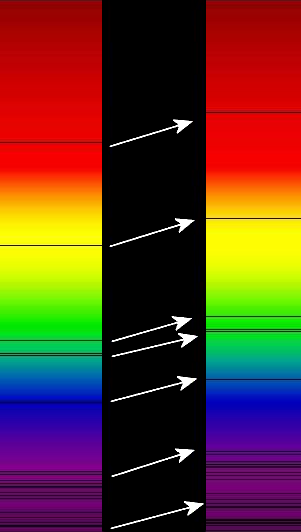 The light from distant stars and galaxies can be separated into a color spectrum, from visible red to violet. A simple prism can do this, much the same as you might use in your window to break sunlight in to a variety of different colors.
 In 1928 a Swiss astronomer by the name of Fritz Zwicky rejected Hubble's assumption by proposing that the light lost energy as it travelled. He called this his "tired light" theory. However, the redshift in the light from galaxies and stars is best explained as being due to nothing more than the light dispersing as it travels towards us.
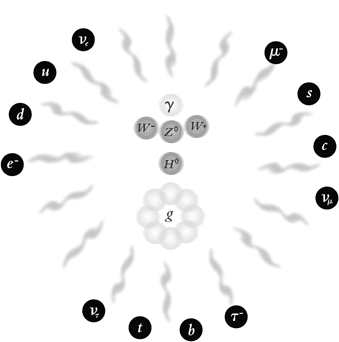 Establishment physics is not an open-minded exploration of the nature of the Universe. It is, in fact, an abstractionist paradigm that does not adequately explain the strictly materialist nature of the Universe. For example, establishment physics sees the attractions called the strong and weak nuclear forces, the electrostatic force, and the gravitational force in abstract mathematical terms and gives no explanation of the material mechanism.
  All of this leads to the conclusion that everything which can be constructed by the process that is the Universe, must exist and re-exist an infinite number of times.